

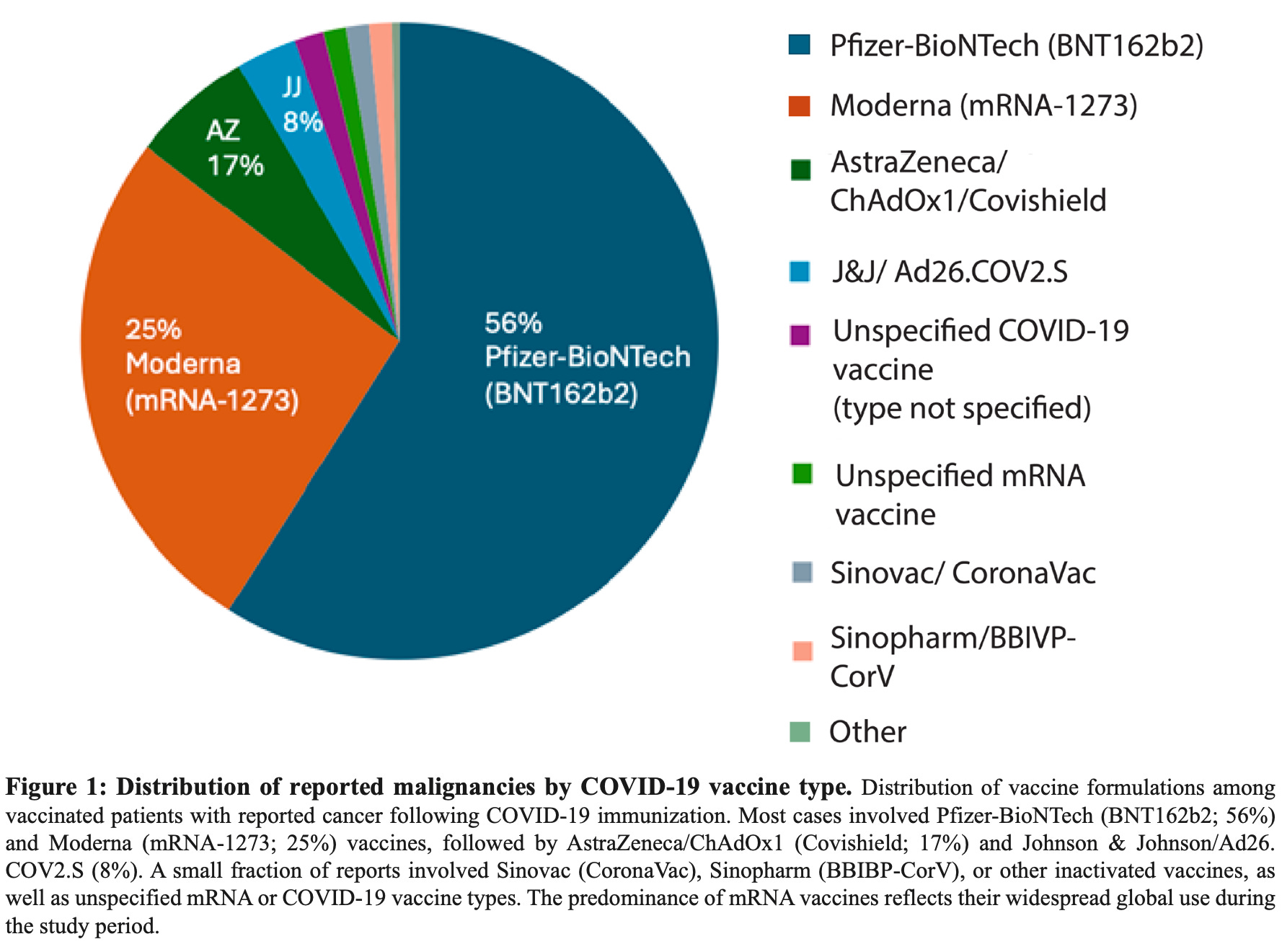
For several years now, clinicians, pathologists, and independent researchers have been documenting turbo cancers following COVID-19 vaccination: sudden relapses, explosive disease acceleration, rare malignancies appearing out of nowhere, and tumors localizing to injection sites or draining lymph nodes. These signals have been visible for some time — but deliberately fragmented, dismissed as coincidence, or buried under claims that “case reports don’t count.”
That excuse has now completely collapsed.
A newly published peer-reviewed systematic review in Oncotarget — authored by Charlotte Kuperwasser, PhD, and Wafik S. El-Deiry, MD, PhD — is the first to formally assemble and analyze the entire published literature on cancer temporally associated with COVID-19 vaccination and SARS-CoV-2 infection.
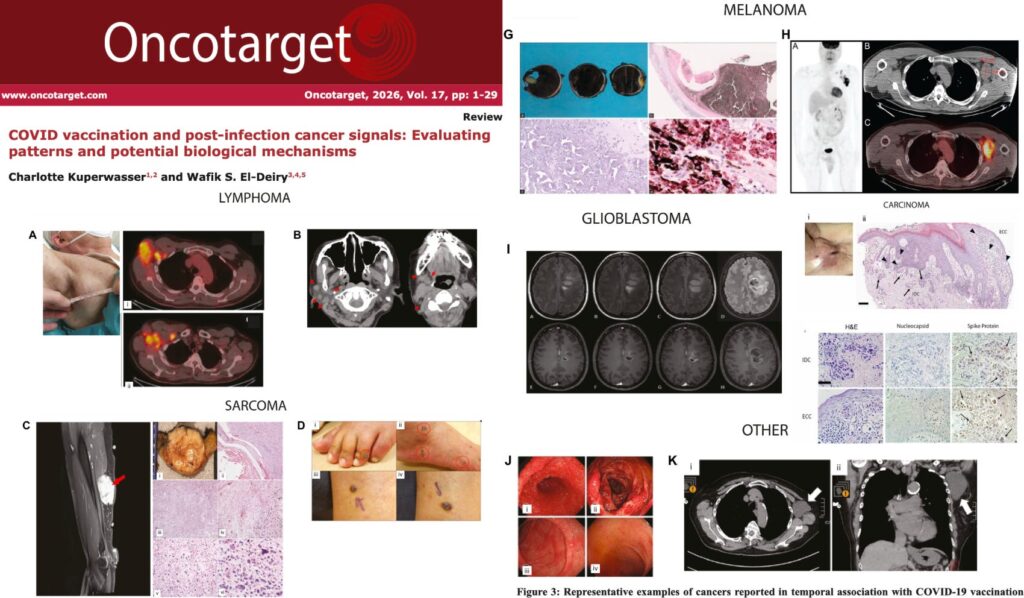
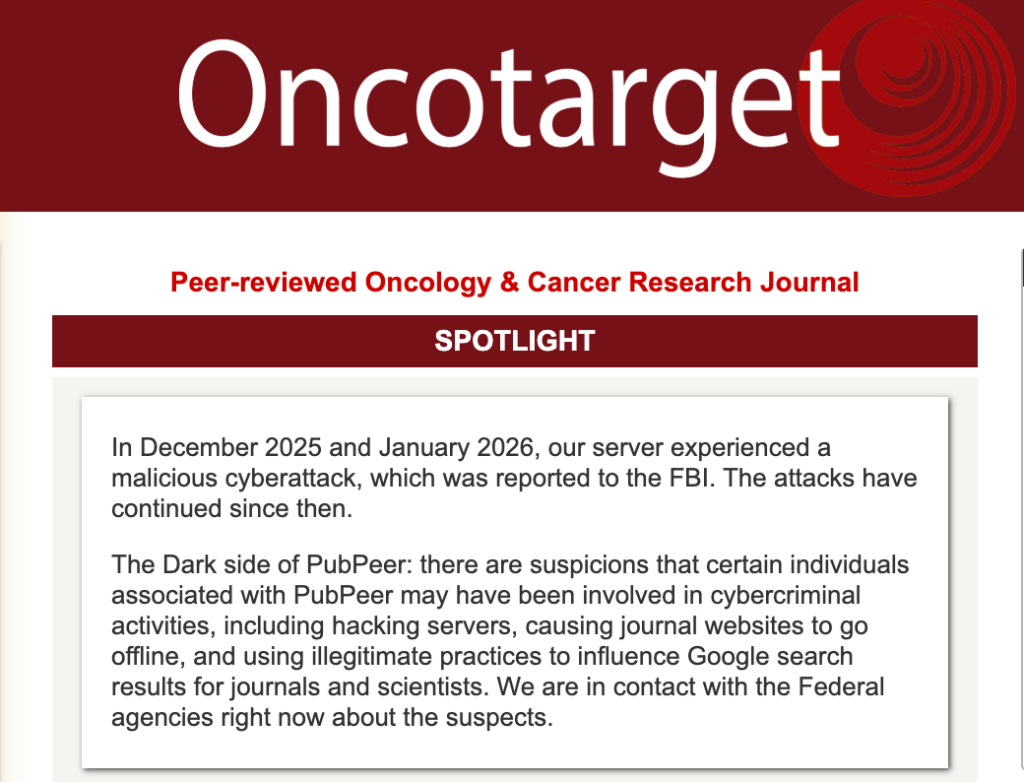
Importantly, while this article has been accepted, published, and assigned a publication date, the journal has disclosed that it is currently unable to add the paper to its live journal index due to an ongoing malicious cyberattack on its servers. According to a statement now posted on Oncotarget’s website — and relayed directly to us by Dr. El-Deiry — the journal experienced sustained cyber intrusions in December 2025 and January 2026, which were reported to the FBI, with attacks continuing into the present. In the meantime, Dr. El-Deiry has provided a link to access this important paper. You can read it here.
The journal further states that it is investigating whether individuals associated with PubPeer (PubSmear Mob) may have engaged in or facilitated cybercriminal activity, including server hacking, taking journal websites offline, and manipulating Google search results to suppress journals and scientists. Oncotarget reports that it is currently in contact with federal law-enforcement agencies regarding identified suspects.
The authors conducted a global, multi-database search (PubMed, Scopus, Web of Science, Google Scholar, React19) covering January 2020 through October 2025, explicitly hunting for cancer diagnoses, recurrences, or aggressive progression following vaccination or infection.
What they ultimately identified is not trivial:
69 peer-reviewed publications
333 individual cancer cases
27 countries
66 article-level case reports and series
2 large population-level cohort studies
1 longitudinal U.S. military cancer surveillance analysis
Multiple mechanistic and translational studies
Taken together, this constitutes the most comprehensive oncologic safety assessment related to COVID-19 vaccination published to date.
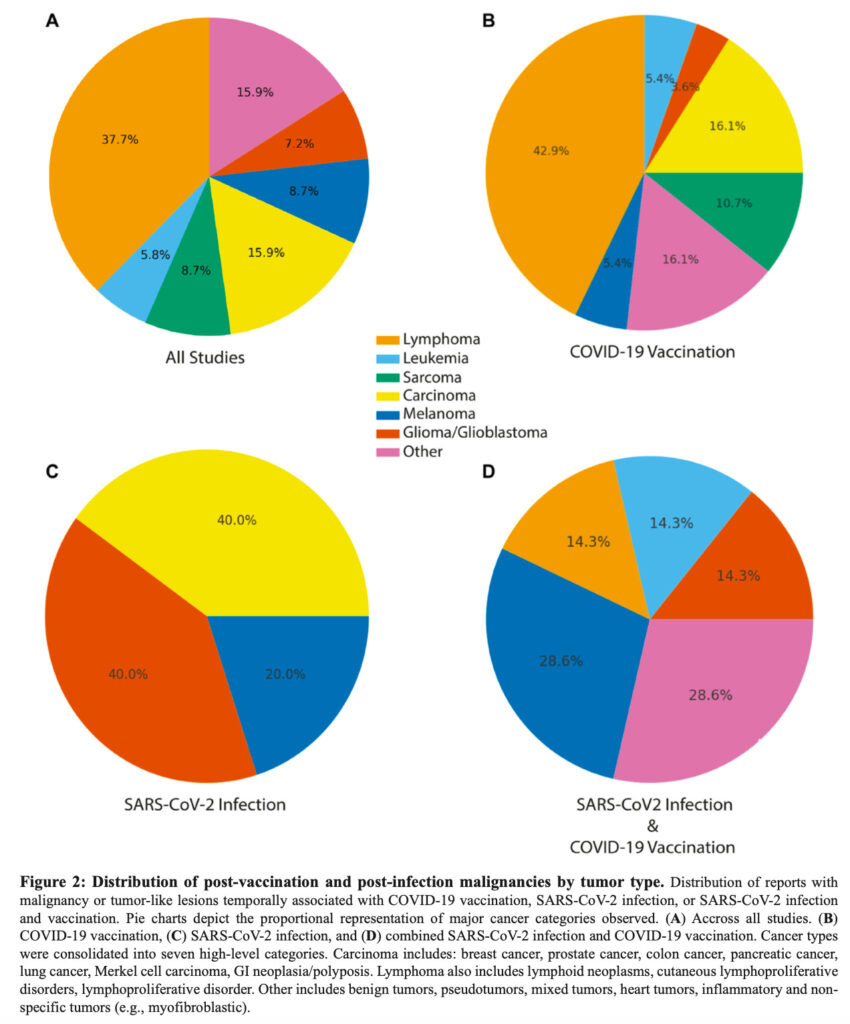
Across all 66 case reports/case series (333 cancer cases), cancers were distributed as follows:
Lymphoma: ~38%
Carcinoma: ~16%
Other tumors: ~16%
Melanoma: ~9%
Sarcoma: ~9%
Glioma/Glioblastoma: ~7%
Leukemia: ~6%
Among COVID-19 vaccination–associated cases, lymphoid malignancies were even more prominent:
Lymphoma: ~43%
Carcinoma: ~16%
Sarcoma: ~11%
Other tumors: ~16%
Melanoma: ~5%
Glioma/Glioblastoma: ~4%
Leukemia: ~5%
SARS-CoV-2 infection–only cases were rare and showed a limited tumor spectrum:
Carcinoma: ~40%
Glioma/Glioblastoma: ~40%
Melanoma: ~20%
Cases involving both SARS-CoV-2 infection and COVID-19 vaccination showed a broader distribution:
Melanoma: ~29%
Other tumors: ~29%
Lymphoma: ~14%
Leukemia: ~14%
Glioma/Glioblastoma: ~14%
Overall, this demonstrates that vaccination-associated reports dominate the dataset, while infection-only cancer reports are comparatively few, and that lymphoid malignancies account for the largest proportion of cases, particularly in the vaccination-associated group.

