

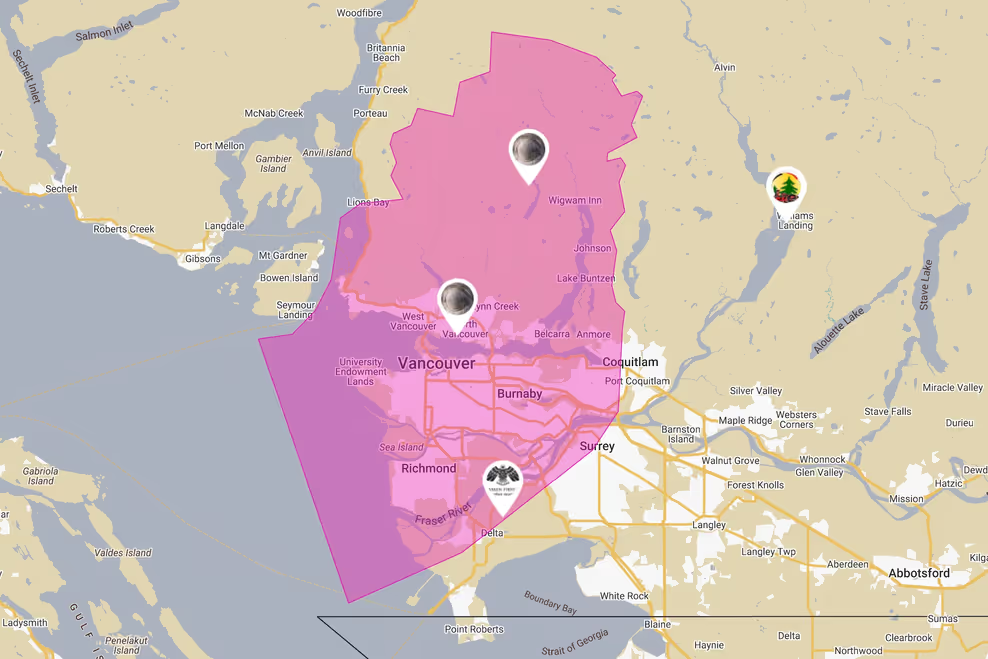
Control over fisheries, marine planning, and emergency response along parts of the South Coast of British Columbia will increasingly be shared with the Musqueam Indian Band under three new agreements signed with the Government of Canada last week.
More importantly, the deals also formally recognize Musqueam’s Aboriginal rights and establish a framework for joint governance in the First Nation’s traditional territory.
These agreements are being described by both sides as a practical step toward implementing Aboriginal rights under the Canadian Constitution, according to a news release.
Rather than a single sweeping deal, the package establishes a framework for gradual implementation.
It recognizes Musqueam’s rights within its territory and sets up formal processes for shared decision-making.
The full details and terms of the agreements are not immediately known, but this “Rights Recognition Agreement” is by far the most consequential, as it “recognizes that Musqueam has Aboriginal rights including title within their traditional territory and establishes a framework for incremental implementation of rights and nation-to-nation relations with Canada.”
In simpler terms, it means the federal government is formally acknowledging that Musqueam holds Aboriginal rights — including Aboriginal title on land — within its traditional territory and is committing to work out, step by step, how those rights will be put into practice. The agreement creates a structured framework for gradually implementing Musqueam’s authority in decision-making over much of the Lower Mainland’s lands and waters.
“Our Musqueam community celebrates these historic agreements as a step forward in our path to Reconciliation. In signing these agreements, the Government of Canada is acknowledging Musqueam’s Aboriginal title and rights to our traditional territory and recognizing our expertise in both marine management and fisheries management,” said Musqueam chief Wayne Sparrow in a statement.
“This is another example of how Musqueam is a leader and is taking a different approach on innovative agreements with partners like the Government of Canada, that benefit the greater community and contribute to a joint sustainable future.”
Their traditional territory includes the region’s mountainous, forested watershed that feed into Metro Vancouver’s drinking water reservoirs, as well as West Vancouver, North Vancouver City, North Vancouver District, Vancouver, the University of British Columbia, the University Endowment Lands, Burnaby, Port Moody, Anmore, Belcarra, New Westminster, Richmond, Vancouver International Airport, the northern areas of Delta and Surrey, and the waterways.

